The AI boom is creating a second buildout: the infrastructure that lets all that compute work together. Photonics sits at its center.
The most interesting thing about an AI cluster is what happens between the chips.
A GPU can calculate at extraordinary speed. A useful AI system also has to move information: between accelerators, between racks, and between facilities. The investment opportunity expands when we stop looking at the processor in isolation and start looking at the machinery required to keep it productive.
That is why I am so bullish on AI photonics.
The evidence now reaches well beyond a promising laboratory demonstration. NVIDIA has announced major optics purchase commitments and investments. Broadcom has brought a new switching generation into production. Optical suppliers are reporting substantial revenue growth. Further upstream, customers are reserving semiconductor material capacity years ahead.
For Sivers followers, this bigger picture matters. It explains why a specialist laser company can be relevant to a much larger infrastructure transition. To understand that opportunity, follow the light all the way from the wafer to the AI system—and follow the commercial evidence back in the other direction.
Research snapshot: September 5, 2026. This feature develops the bullish thesis. Reported results, company plans, and my interpretation are identified throughout.
1. The strongest signal: customers are committing capital
On March 2, NVIDIA announced a nonexclusive agreement with Lumentum that includes a multibillion-dollar purchase commitment and future capacity rights for advanced laser components. Separately, NVIDIA announced a $2 billion investment to support Lumentum’s research, capacity, and manufacturing expansion. These are different commitments: an investment in the supplier and a commitment to purchase its products. NVIDIA–Lumentum agreement
The same day, NVIDIA announced a nonexclusive strategic agreement with Coherent, again combining a multibillion-dollar purchase commitment and capacity rights with a separate $2 billion investment. The stated purpose includes advanced lasers, optical networking, manufacturing, and research. NVIDIA–Coherent agreement
My interpretation is straightforward: optical supply has become important enough for a major AI platform company to help finance and secure it directly.
That is a much stronger foundation for a bullish thesis than a slide predicting a large market. It connects the technical need to a commercial response. Buyers want access to the components; suppliers need the capacity to deliver them.
Now move another step upstream. In July, AXT announced a long-term agreement to supply and reserve indium phosphide wafer capacity for Lumentum through the end of 2031. The agreement provides for an initial $43.5 million deposit, with a second deposit of the same amount whose timing and terms are to be determined during 2028. These deposits become credits against product shipments. They are capacity commitments, not revenue already recognized. AXT–Lumentum agreement
This creates a particularly useful chain of evidence: NVIDIA commits to Lumentum; Lumentum reserves capacity with AXT. Both links are documented. The exact products ultimately connecting the agreements are not disclosed, so this is a view of commercial interdependence, not a claim that every AXT wafer goes into an NVIDIA system.
The bullish implication is still powerful: demand for AI connectivity can pull investment into suppliers several layers removed from the GPU.
2. How an optical connection actually works
The basic sequence is easier to understand than the terminology suggests.
A laser produces light. A modulator encodes information onto that light. Optical paths carry the signal, and a photodetector converts the arriving light back into an electrical signal. Electronics drive, receive, and process those signals. Intel’s integrated-link work provides a clear example of these building blocks working together. Intel’s optical-link explanation
A transceiver packages transmitting and receiving functions into a usable connection. A photonic integrated circuit, or PIC, integrates optical functions on a chip. Silicon photonics brings optical devices together with manufacturing methods familiar from the semiconductor industry. Intel describes its modern optical-compute interconnect approach in terms of the bandwidth, reach, and energy efficiency needed to connect larger compute systems. Intel silicon photonics
For investors, the important distinction is between making the light, manipulating the light, and packaging a complete product. Those are related jobs, but they are not identical businesses.
The location of the optics matters too. Pluggable optics sit in removable modules at the equipment faceplate. Co-packaged optics, or CPO, place optical engines much closer to the switching or compute silicon. That shortens the demanding electrical journey before data becomes an optical signal. Broadcom’s Davisson platform is one concrete implementation of that approach. Broadcom’s CPO architecture
These architectures can coexist. NVIDIA’s latest quarterly release explicitly describes Spectrum-6 systems supporting both pluggable and co-packaged optics. That is an especially attractive feature of the sector thesis: growth can come through the established module ecosystem while new optical integration creates additional opportunities. NVIDIA’s latest platform update
There is another useful distinction. Scale-out connects machines across a wider network. Scale-up tightly connects accelerators so a larger group can cooperate on a workload. Scale-across extends connectivity between facilities. Marvell’s portfolio spans optical approaches across all three, illustrating how many parts of the system now need attention. Marvell’s interconnect portfolio
The opportunity is therefore larger than one connector standard or one new box. It includes the components, fabrication processes, packaging methods, and manufacturing capacity needed to make better connections economical at scale.
3. The map: what each layer supplies
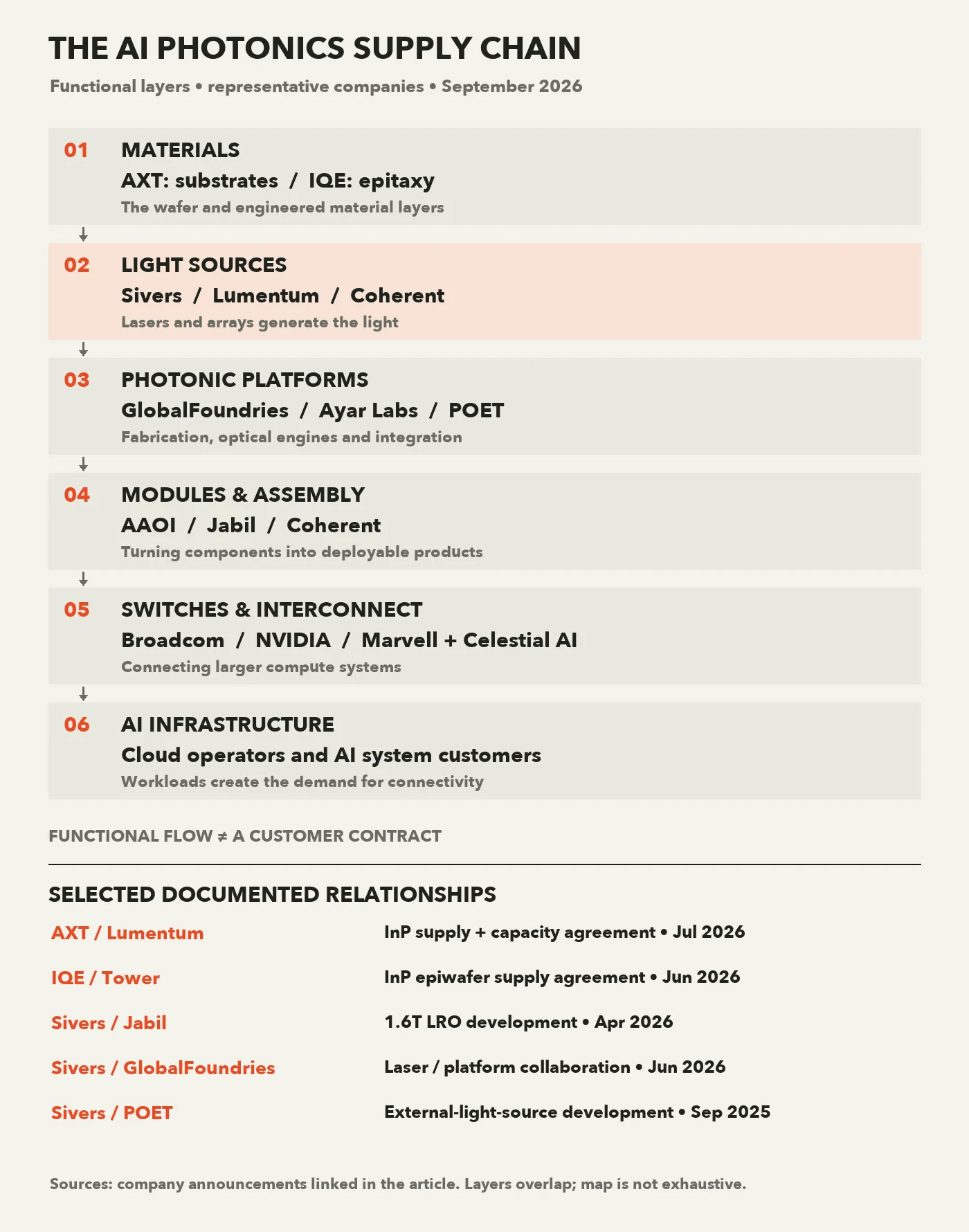
Materials: the foundation beneath the device
Before a laser becomes a product, there must be suitable semiconductor material. Indium phosphide, or InP, is an important material for optical communications because of its direct-bandgap properties and compatibility with optoelectronic devices. A substrate is the starting wafer; epitaxy adds carefully controlled crystalline layers that help give a device its operating characteristics. IQE’s InP overview
AXT supplies compound-semiconductor substrates. Its July results described a record quarter for InP revenue and linked customer demand to data-center optical connectivity. This is useful evidence that the optical buildout is reaching the materials layer, although AXT’s overall revenue includes other products. AXT Q2 results
IQE provides another view through epitaxy. Its June agreement with Tower Semiconductor covers InP epiwafers for optical connectivity, including technology for 200G-per-lane pluggables and prototyping for a subsequent 400G-per-lane generation. That is a documented supplier relationship tied to a technical roadmap. IQE–Tower agreement
The materials opportunity is also broader than a single chemistry. In September, IQE announced a purchase agreement supporting Quintessent’s quantum-dot-laser customer sampling using six-inch gallium arsenide epiwafers. That is a different material platform from InP. It shows why a useful industry map identifies what each supplier actually makes rather than putting every photonics company into the same category. IQE–Quintessent update
Lasers: generating the optical signal
This is where Sivers, Lumentum, and Coherent become particularly relevant.
Laser suppliers help determine the quality, power, and efficiency of the light available to the rest of the system. Sivers focuses on products including distributed-feedback, or DFB, lasers and arrays. The laser is a component within a larger architecture, which gives it potential routes into multiple downstream platforms. Sivers’ photonics products
Lumentum and Coherent also offer broader optical portfolios. Their NVIDIA agreements show how advanced laser and optical-networking capabilities can become strategic assets for customers. The bullish question is not simply whether a supplier can make a laser. It is whether it can make the right device, meet the customer’s requirements, and repeat that performance across production volumes.
Foundries and optical engines: turning devices into a platform
GlobalFoundries supplies silicon-photonics technology and a manufacturing ecosystem that includes packaging and test capabilities. Its SCALE optical module platform combines functions such as modulators and photodiodes with integration features intended for CPO. It has demonstrated multiple wavelengths sharing optical fibers—a way to expand bandwidth density rather than treating every new channel as an entirely separate physical connection. GlobalFoundries SCALE
That gives specialist component companies an important route toward larger systems. A laser can support a platform used by designers building an optical engine. The foundry contributes a repeatable process; the component supplier contributes a differentiated part of the design; the customer assembles those capabilities into a product.
Ayar Labs works at the optical-engine and chiplet layer with TeraPHY. In March, the private company announced $500 million of financing intended to expand production and test capacity. The financing is evidence of resources being committed to commercialization, not a customer order. Its relevance is that deployment requires an industrial manufacturing system around the technology. Ayar Labs financing
Modules and integration: making optics deployable
Applied Optoelectronics, or AAOI, is a useful example of the module business. Its high-speed transceivers translate an optical architecture into products customers can install. The company’s latest results and expansion targets give a measurable view of the 800G and 1.6T opportunity. We will examine those figures below.
POET approaches integration through its Optical Interposer and newer Electrical-Optical Interposer work. In May, POET and Lumilens announced a joint development and commercial agreement focused on wafer-level optical integration. The initial $50 million order depends on successful development, qualification, and manufacturing scale-up. That makes it a concrete commercial framework with stated conditions, rather than revenue already delivered. POET–Lumilens agreement
The attractive idea is manufacturing repeatability. If optical assembly can become more efficient and reproducible, the industry can support higher volumes while improving the economics of the connection. That is why integration deserves attention alongside the headline specifications of a laser or switch.
Switches and system platforms: pulling the ecosystem forward
Broadcom announced production-volume shipments of its 102.4-terabit-per-second Tomahawk 6 family in March. It describes the new generation as doubling the throughput of Tomahawk 5. Separately, the company announced its CPO-based Tomahawk 6–Davisson product in October 2025. The distinction matters: the family’s production announcement is not a claim that every Tomahawk 6 deployment uses CPO. Tomahawk 6 production · Davisson announcement
Marvell completed its acquisition of Celestial AI in February, bringing Photonic Fabric into its data-center business. The deal gives Marvell a direct position in optical scale-up connectivity alongside its wider interconnect portfolio. Celestial AI should therefore appear inside Marvell on a current industry map, rather than as an independent public stock. Marvell acquisition completion
NVIDIA sits at the system-platform end of this map, connecting compute, switches, software, and supplier ecosystems. Its support for multiple optical architectures helps explain why the supplier opportunity can develop in several directions at once.
4. The company comparison: different ways to capture the opportunity
This table compares business roles, not stock valuations. Several companies operate across more than one layer; the role shown is the one most relevant to this feature.
Company | Role in the map | Bullish opportunity to follow |
|---|---|---|
NVIDIA | AI systems and networking | Optical connectivity supports larger, more productive AI systems. |
Broadcom | Switching silicon and CPO | Higher-throughput switching and closer optical integration. |
Marvell, including Celestial AI | Interconnect silicon and optical scale-up | More optical connectivity across scale-out, scale-up, and scale-across. |
Coherent | Lasers, components, and optical products | Growing datacenter demand plus committed customer investment. |
Lumentum | Lasers and optical products | Capacity expansion supported by the NVIDIA agreement. |
Applied Optoelectronics | Optical transceivers | Expansion of high-speed module production and shipments. |
Sivers | DFB lasers and arrays | Multiple platform collaborations and a larger manufacturing base. |
POET | Optical engines and integration | Turning wafer-level integration into qualified commercial products. |
Ayar Labs — private | Optical engines and chiplets | Manufacturing and test scale for optical accelerator connectivity. |
GlobalFoundries | Silicon-photonics foundry platform | Fabrication, integration, packaging, and ecosystem adoption. |
Jabil | Photonics engineering and manufacturing | Developing manufacturable optical modules with component partners. |
AXT | Semiconductor substrates | Reserved InP capacity and demand from optical-device makers. |
IQE | Epitaxy and semiconductor materials | Supplying the material layers behind multiple optical technologies. |
Sources for the company roles are linked in the corresponding sections above and in the Sivers section below. A position in the same layer does not establish a supplier relationship between two companies.
My way of reading this table is to ask what the customer is paying each company to solve. At one layer it is a reliable wafer. At another it is a light source. Further downstream it is a qualified module, a high-capacity switch, or a complete working system.
Revenue can accumulate at several of these layers during the same infrastructure expansion. But adding every company’s market estimate together would count overlapping value repeatedly. The more useful exercise is to identify the specific product, the buyer’s requirement, and the route from design work to shipments.
5. Two charts that put the opportunity into perspective
Coherent: substantial growth in the relevant segment
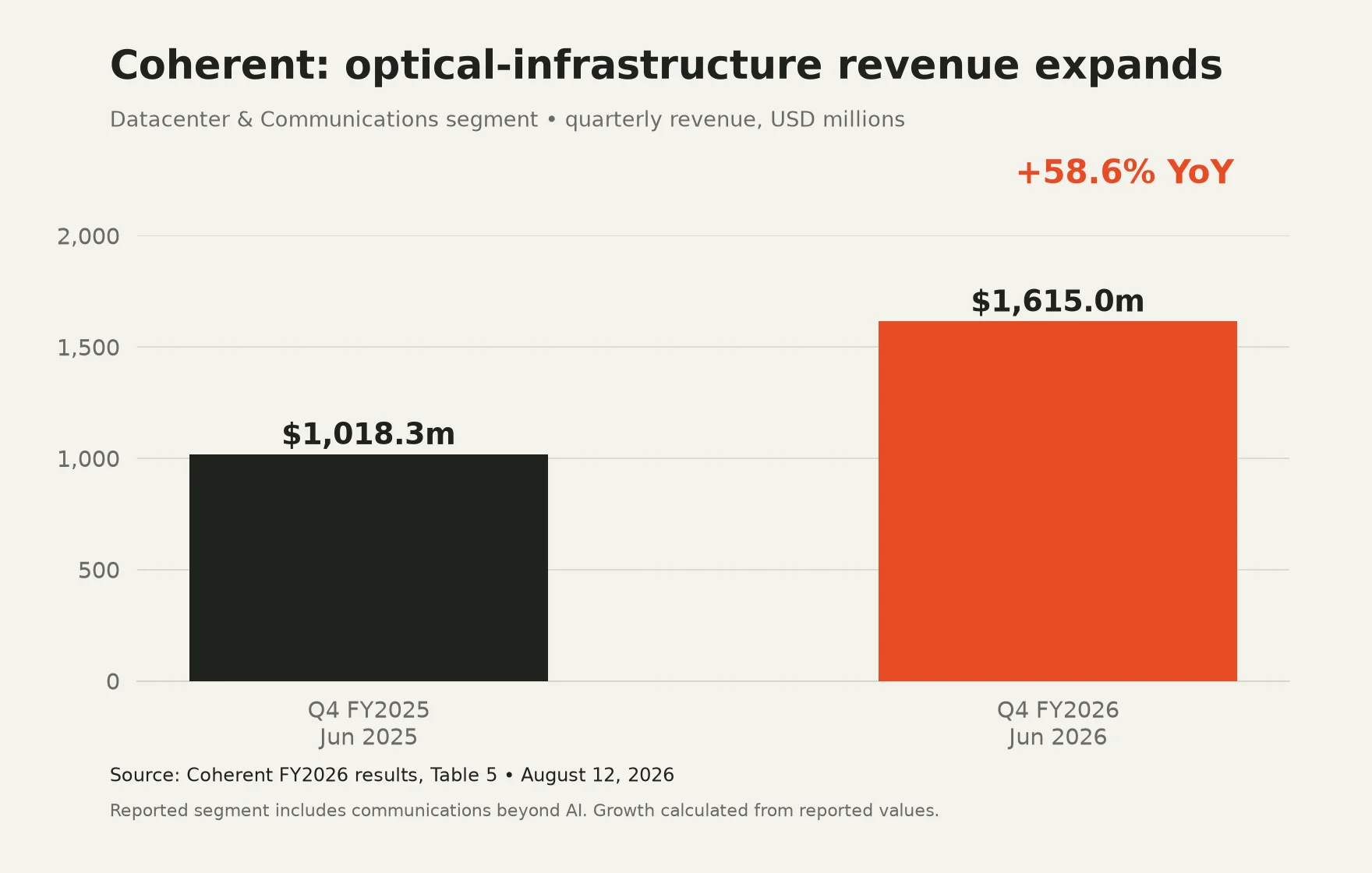
Coherent reported $1.615 billion of Datacenter & Communications revenue for the quarter ended June 30, 2026, compared with $1.0183 billion a year earlier. That is approximately 58.6% growth, calculated from the reported segment values. The segment includes communications activity beyond AI, so the chart should be read as optical-infrastructure exposure rather than pure AI revenue. Coherent FY2026 results, Table 5
The significance is the absolute scale. This is already a substantial commercial business growing from a large base. It supplies an important counterweight to the idea that the whole photonics thesis depends on technologies that have yet to find customers.
For the broader map, an established supplier’s growth also gives context to smaller companies. It helps explain why customers and investors are paying attention to additional capacity, alternative integration approaches, and specialist components. It does not assign those smaller companies a share of Coherent’s sales; it establishes that the market they are trying to serve is economically meaningful.
AAOI: reported growth followed by a higher company outlook
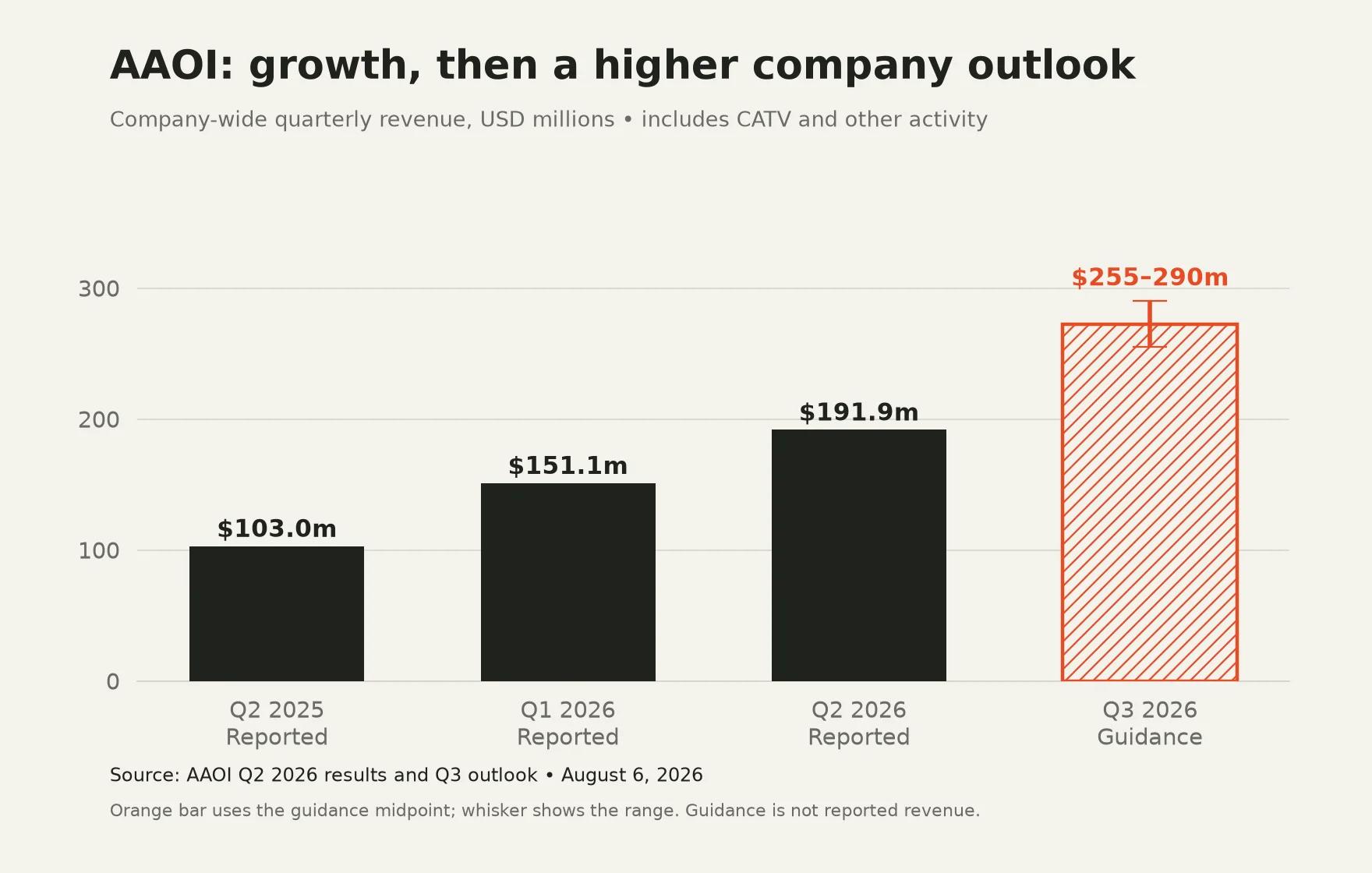
AAOI reported total quarterly revenue of $103.0 million in Q2 2025, $151.1 million in Q1 2026, and $191.9 million in Q2 2026. Its August outlook put Q3 revenue at $255–290 million. The chart keeps the forecast visually separate from reported results. These are company-wide figures, including CATV activity, rather than an AI-only sales series. AAOI Q2 results and outlook
In the same release, management targeted approximately 650,000 units per month of 800G and 1.6T production capacity by year-end 2026. Capacity is the ability to produce, not a statement that every unit will ship. The target nevertheless shows the magnitude of the manufacturing expansion management is pursuing.
Together, the two charts illustrate complementary parts of the bull case: a large optical supplier reporting substantial segment growth, and a module supplier preparing for a higher operating scale. The common thread is the attempt to turn demand into repeatable production.
6. Where Sivers fits—and why the position is compelling
Sivers becomes much more interesting when we locate it precisely.
Its role is not to build the whole AI network. Its opportunity is to supply a specialized part of the optical system that other companies need to make their own products work. The company’s DFB lasers and arrays are relevant to the light-source layer, and its documented collaborations reach into both pluggable modules and emerging integrated optical architectures. Sivers products
That gives the thesis breadth without requiring us to invent an undisclosed customer. There are already named relationships to investigate.
The pluggable route: Jabil
In April, Sivers announced that Jabil planned to develop a 1.6T linear-receive-optical transceiver using Sivers DFB lasers. Jabil also lists the collaboration in its own newsroom. The announcement establishes development work on a specific product architecture; it does not disclose a production order or a shipment volume. Sivers–Jabil announcement · Jabil newsroom
The bullish point is the application. Sivers has a documented route into the high-speed pluggable market, not only a thesis about distant CPO adoption. Jabil contributes module engineering and manufacturing experience; Sivers contributes the laser technology. A successful qualified product would give that relationship a clearer route into repeat shipments.
The foundry-platform route: GlobalFoundries
The June collaboration with GlobalFoundries connects Sivers’ laser arrays to GF’s silicon-photonics platform and SCALE optical-engine solutions. GF’s own technology page links the announcement, providing counterparty corroboration. Sivers–GlobalFoundries announcement · GF technology platform
This is important because a platform can bring multiple specialized capabilities together. Sivers does not need to replicate the foundry’s entire process or design the customer’s complete system to contribute something valuable. The business opportunity lies in becoming a qualified component within a useful, repeatable architecture.
My bullish interpretation is that the relationship strengthens Sivers’ access to the wider design ecosystem. That is different from assigning a revenue figure to every GF customer. The evidence supports platform participation, and that is meaningful on its own.
The external-light-source route: POET and Ayar Labs
POET and Sivers announced their external-light-source collaboration in September 2025. The intended combination is Sivers’ high-power DFB lasers with POET’s Optical Interposer, using wafer-level manufacturing and integration to address size, cost, and scalability. The original announcement targeted production readiness by the end of 2026; that remains a dated company target rather than a milestone assumed completed. POET–Sivers agreement
An external light source is an attractive place to focus because it lets the optical engine and the source of light be engineered as distinct parts of the system. The commercial question becomes whether the combination can meet customer requirements and be manufactured consistently. Successful qualification would make the relationship easier to evaluate through real products rather than concept diagrams.
There is also a historical technical connection to Ayar Labs. At ECOC 2023, Ayar documented a demonstration in which an eight-wavelength Sivers DFB array powered its SuperNova light source. That is evidence of integration experience, not proof of a current exclusive supply contract. Ayar’s Sivers demonstration
Taken together, these relationships make the Sivers story more substantial than a company merely describing a large addressable market. They put its technology alongside identifiable downstream architectures. Each relationship deserves its own commercial milestones, but the collection gives us a useful map of potential routes to scale.
The next device generation: SemiNex
In August, Sivers and SemiNex announced a program initially valued at approximately $3.4 million, targeting advanced InP light sources. The work includes high-power sources, multi-wavelength DFB arrays, and semiconductor optical amplifiers. Customer sampling and early production ramps are targeted for the second half of 2027. Sivers–SemiNex program
The technical direction matters: as optical systems carry more channels, the performance of the light source becomes part of the system design. My inference is that expertise in efficiency, wavelength control, and manufacturability can become more valuable as customers ask the laser to do more. The program is a concrete development activity directed at those requirements.
The manufacturing route: Glasgow and a hybrid model
The most recent development is Sivers’ September announcement of a planned $30 million expansion in Glasgow. Management expects the completed facility to support more than 100 million CW DFB lasers annually, with work beginning in the second half of 2026 and operations targeted for Q4 2027. Those are future capacity and timing expectations, not current production output. Glasgow expansion announcement
The company describes a hybrid manufacturing strategy combining more internal capability with external foundry, packaging, and manufacturing partners. My interpretation is that Sivers is trying to make capacity availability part of its customer proposition. The value of a component improves when the buyer can plan a product ramp around a credible path to supply.
The transition is visible in management’s stated priorities. Its Q2 release describes a shift toward product-led growth and preparation for customer production ramps in 2027. The detailed financial highlights show product/HW revenue growth of 13% as reported, or 18% adjusted for currency. The headline should not erase that distinction. Sivers Q2 report
This is the Sivers bull case I find most compelling: several documented routes into optical architectures, paired with an effort to build the manufacturing capability to serve them. The thesis is about converting technical participation into a larger product business. That is a more useful foundation than attaching the company to every attractive name in the sector.
7. What could turn this into a durable expansion
The strongest version of the sector thesis has three reinforcing mechanisms.
First, more useful compute needs better connections. If an improved connection helps a customer use expensive infrastructure more effectively, the value proposition reaches beyond the price of the optical component. The customer is evaluating a system. That gives suppliers a reason to compete on power, density, reliability, and manufacturability together.
Second, more than one architecture can create demand. Higher-speed pluggables, optical scale-up, and co-packaged switching address different design requirements. Broadcom’s OFC portfolio includes work on higher per-lane rates and future module generations, showing that the development pipeline extends beyond one bandwidth transition. Broadcom at OFC 2026
Third, manufacturing progress can widen adoption. Better integration and more repeatable assembly can make a technically attractive product commercially practical. The bullish opportunity includes companies that improve that process, not just those advertising the fastest device. GlobalFoundries’ packaging and platform work is one example of the industrial infrastructure behind adoption. GF’s manufacturing ecosystem
There is supporting evidence at other points on the map too. IQE’s July update anticipated at least £64 million of first-half revenue and more than 30% full-year revenue growth, describing accelerating InP demand among the drivers. These were company expectations for a group with several end markets, not an AI-only revenue forecast. IQE trading update
My conviction comes from the combination. A single announcement can be interesting; a series of technical, commercial, and manufacturing commitments across independent businesses is much more revealing. It suggests that the buildout is becoming an ecosystem effort.
For an investor researching that ecosystem, the next useful question is not “Which ticker has photonics in its story?” It is “Which company provides something the next architecture needs, and what evidence will show that contribution becoming a repeatable business?”
8. The milestones worth coming back for
The map becomes more valuable when it is connected to observable progress. These are the next checkpoints I would use:
Next quarterly results: whether high-speed optical demand continues to translate into reported sales at established suppliers. Keep segment figures separate from company-wide totals.
By the end of 2026: AAOI’s progress toward its stated 800G/1.6T capacity target, and updates on the production-readiness goal originally announced by POET and Sivers.
Late 2026 into 2027: the engineering-sample and production milestones described in POET and Lumilens’ EOI program. The announced timetable links late-2026 samples to a 2027 ramp, subject to development and qualification.
Second half of 2027: the sampling and early-ramp targets in the Sivers–SemiNex program.
Q4 2027: the planned operational milestone for Sivers’ expanded Glasgow facility.
These dates come from the linked AAOI, POET–Sivers, POET–Lumilens, SemiNex, and Glasgow announcements. They are company targets to track, not dates on which results are guaranteed.
The most informative update will often be a change in commercial stage: a demonstrated device becomes a qualified component; a qualified component becomes a production order; a production order becomes recurring shipments. That sequence gives readers a way to follow progress without relying on a new market-size estimate every week.
9. Follow the light. Then follow the revenue.
The AI photonics opportunity is compelling because it connects a physical requirement to a growing industrial response.
At one end are the AI systems. At the other are materials, lasers, fabrication processes, and specialized manufacturing capabilities. Between them sits the work of turning light into dependable, high-bandwidth connections.
I am bullish on the companies that can make those connections work at scale. Some already have large revenue bases. Others are building their way toward commercial volume. Understanding the difference lets us appreciate the size of the opportunity without confusing a promising roadmap with a finished business.
For Sivers, the attraction is its position in the light-source layer and the named routes through which that technology could reach more systems. For the sector, it is the breadth of demand that can support several suppliers and architectures simultaneously.
The next stage of AI infrastructure will reward more than the ability to calculate. It will reward the ability to connect.
That is why I believe photonics deserves a central place in the AI research conversation.
Save this research, follow the Photonics topic, and add your questions or primary sources to the discussion below. For shorter observations and follow-up research, find me on X at @molelabs.
Source shelf
Original announcements, technical references, and financial disclosures used in this feature:
NVIDIA: NVIDIA–Lumentum strategic agreement — 2026-03-02.
NVIDIA: NVIDIA–Coherent strategic agreement — 2026-03-02.
AXT: Long-term Lumentum supply agreement — 2026-07-29.
Intel: Integrated optical-link building blocks — 2010-07-27.
Intel: Silicon photonics and Optical Compute Interconnect — accessed 2026-09-06.
Broadcom: Tomahawk 6–Davisson CPO announcement — 2025-10-08.
NVIDIA: Second-quarter fiscal 2027 results — 2026-08-26.
Marvell: Q1 FY2027 results and interconnect portfolio — 2026-05-27.
IQE: Indium phosphide substrates — accessed 2026-09-06.
AXT: Q2 2026 results — 2026-07-30.
IQE: Tower multi-year InP epiwafer agreement — 2026-06-15.
IQE: Quintessent quantum-dot-laser epitaxy agreement — 2026-09-03.
Sivers: Photonics products — accessed 2026-09-06.
GlobalFoundries: SCALE optical module platform — 2026-05-04.
Ayar Labs: $500M Series E financing — 2026-03-03.
POET: Lumilens EOI agreement — 2026-05-14 (page May15).
Broadcom: Tomahawk 6 production-volume shipments — 2026-03-12.
Marvell: Completed Celestial AI acquisition — 2026-02-02.
Coherent: Q4 and FY2026 results, Table 5 — 2026-08-12.
Applied Optoelectronics: Q2 2026 results, Exhibit99.1 — 2026-08-06.
Sivers: Jabil 1.6T LRO collaboration — 2026-04-15.
Jabil: Jabil newsroom: Sivers collaboration — 2026-04-15 listing.
Sivers: GlobalFoundries collaboration — 2026-06-02.
GlobalFoundries: Silicon photonics technology — accessed 2026-09-06.
POET: Sivers external-light-source collaboration — 2025-09-29.
Ayar Labs: Sivers–SuperNova joint demonstration — 2023 ECOC.
Sivers: SemiNex $3.4M program — 2026-08-13.
Sivers: Glasgow $30M manufacturing expansion — 2026-09-03.
Sivers: Q2 2026 interim results — 2026-08-27.
Broadcom: OFC 2026 technology portfolio — 2026-03.
IQE: H1 2026 trading update — 2026-07-21.